Why Choose Arbtech?
Watch this video to see why Arbtech are the best asset you can possibly have when you need ecology or tree surveys to help you obtain planning permission.
Through various ecology and environmental lighting services, a development site can be lit in a way that is energy efficient, aims to reduce carbon footprint, and avoids causing a negative environmental impact. For a referral to a specialist provider of environmental and ecological lighting solutions, contact Arbtech today.



Secure planning and protect local wildlife with professional environmental lighting solutions.
We provide expert referrals to trusted partners for wildlife-sensitive lighting design, dark sky-compliant schemes and ecological impact assessments.
While Arbtech focuses on your ecology and tree surveys, we’ll connect you with specialist engineers to ensure your external lighting meets BREEAM, LEED and ILP standards.
Get a coordinated approach that satisfies the local planning authority and keeps your project moving forward.

The right lighting can reveal space and create mood. But when it’s designed without care, it can have a significant effect on the world around us.
For developers and planners, the challenge is finding a way to illuminate a development site for safety and aesthetics without causing a negative impact on the local ecosystem.
Environmental and ecological lighting solutions are the answer. With environmentally-friendly lighting, you can support your planning project’s goals while ensuring that artificial light doesn’t disrupt the psychology and biology of all living things.
Only under the highest industry benchmarks can you ensure that every lighting solution chosen for a development is reputable and trustworthy.
All lighting services follow the strict guidance of the Institution of Lighting Professionals (ILP), specifically GN08/23. We ensure designs use warm-spectrum light (≤2,700 Kelvin) and peak wavelengths >550nm to prevent disruption to the biology of nocturnal wildlife.
The correct approach incorporates sustainable lighting principles aligned with BREEAM and LEED certifications. All lighting services follow the strict guidance of the Institution of Lighting Professionals (ILP), especially when it comes to the colour spectrum and the reduction of blue light, which is known to be extremely disruptive to wildlife.
By adhering to these standards, innovative solutions can turn into reliable results that satisfy even the strictest requirements for planning permission.
A professional ecological lighting impact assessment sets the basis for any sensitive development.
The process involves a lighting specialist evaluating how exterior lighting will interact with the surrounding area. Plans for external lighting will specifically look at everything from light emission levels to associated carbon emissions, helping to make the proposed development efficient and free from obtrusive light.
With the help of the latest lighting technology like advanced LED lighting, developers and planners can get expert support to help navigate complex planning conditions.
Examples of ecology lighting solutions include:
Creating lighting schemes that work in harmony with nature.
A lighting designer selects lighting products that use less energy and have a specific light source orientation to prevent light spill (sky glow). The friendly lighting design ensures that the artificial lighting serves its purpose without having an adverse effect on the landscape.
Providing bat-friendly lighting that avoids bright whites.
We utilise the warm colour spectrum (≤2,700K) and directional hardware like baffles and louvres to maintain dark corridors, preventing artificial light from acting as a barrier to nocturnal species.
Loads of developers and planners work on development sites with bat boxes or water bodies. A bat lighting strategy or a plan for another protected species sees lighting solutions that aren’t at all disruptive.
Following standards that are designed to reduce light pollution by ensuring no light is directed upwards.
It is often a requirement to protect the night sky, especially in rural areas. By managing the light spill and focusing the beam only where it’s needed and at the right time, the darkness of the countryside can be preserved.
Focusing on any actions that would reduce energy and general energy use through the use of modern lighting controls and sensors.
Energy efficiency is at the heart of low-impact lighting. It not only lowers a site’s carbon footprint but also ensures that energy consumption is kept to a significant portion of what traditional lighting would need.
Implementing innovative solutions – like cowls, louvres and shields – to significantly limit light trespass.
Whenever a planning project is near a sensitive habitat, lighting design with a focus on mitigation is one way to support planning approval. More than anything, it ensures that light sources never interfere with the environment’s right to darkness.
The results of all services are then laid out in a comprehensive ecological lighting plan after the checks have been completed.
Reports display technical data needed to prove that the planning project meets the goals needed before planning permission can be granted by the local planning authority.
By showing a clear path to reduce carbon emissions and protect the standard of biodiversity, the strategies directly benefit planning and developers through speeding up the approval process and mapping out sustainable lighting for use on the site.

With so many years of experience in the ecology sector, we understand the complexities of the landscape and all species that live within it.
Although Arbtech can offer ecological expertise, we outsource technical design and modelling for issues related to lighting to a trusted partner company.
Via the third-party company we work with, clients can get a high-level environmental lighting service that combines ecological data with professional engineers.
Our consultancy has worked with all sorts of different problems when it comes to staging a development and getting planning consent, so we are either able to do the work ourselves or outsource it to someone who can.
All of the ecological and environmental lighting services listed above aren’t carried out by the team at Arbtech. Instead, we send all quotes for environmental and ecological lighting solutions to a trusted partner company we recommend based on countless positive reviews, impressive case studies and satisfied clients.
By choosing to request a referral through us, you can make sure that your lighting design is perfectly synced with any ecology surveys you may need, as well as any other assessments and reports we’ve helped you with. And even if you don’t need anything else from us, our reputation speaks for itself, and that passes on to the reputation of any company we work with.
Get in touch with our team today over the phone, via email or by filling out a quote form, and we will forward your details for a free quote and be able to arrange an introduction to our partner company. From there, you can get the lighting report you need to get your planning application accepted by the local authority.

Editor at Arbtech, Rob is a content specialist who manages our ecology and arboriculture services copy to ensure it is accurate, up to date, and insightful for current and future clients.
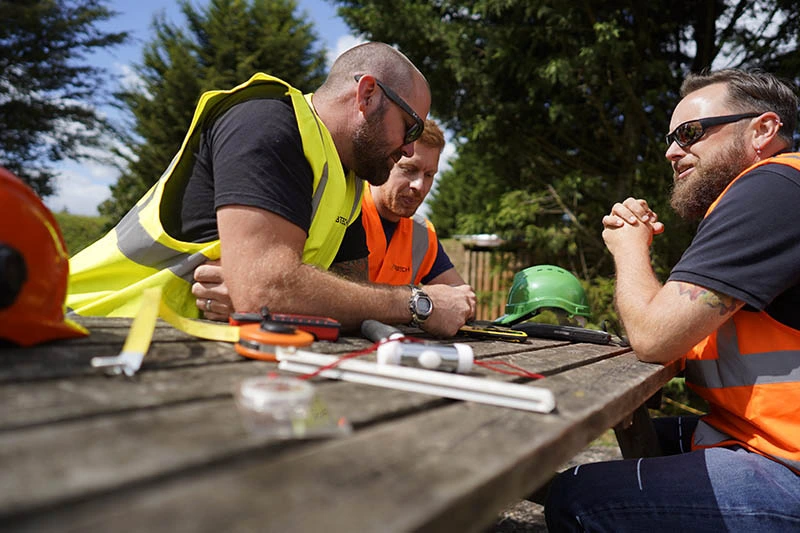
Arbtech are your best asset when it comes to getting planning permission for your project. We cover the whole of the UK and we are waiting to get started on your project...
Get Your Free Quote