Why Choose Arbtech?
Watch this video to see why Arbtech are the best asset you can possibly have when you need ecology or tree surveys to help you obtain planning permission.
If there are suspected bat roosts, signs of bat activity or suitable features for roosting bats on your Leicester site, bat surveys will be needed.
Guided by the Bat Conservation Trust (BCT) and Natural England, our team can undertake both phase 1 and 2 bat survey services to give you next steps in your plans and boost your planning submission.



Anyone planning building works in Leicester and wider Leicestershire must consider local wildlife before a local authority will validate an application.
The presence of natural waterways like the River Soar alongside sprawling green pockets such as Bradgate Park and the Grand Union Canal corridor makes both rural fringes and urban postcodes highly suitable to support roosting bats.
As older Victorian terraces, industrial heritage properties and traditional barn conversions provide cracks, gaps and warm roof voids, various bat species often establish bat roosts unnoticed.
Due to national planning requirements demanding that development projects do not harm local biodiversity, planning applications that fail to address potential ecological constraints are likely to face immediate refusal.
Under UK law, all bats receive complete legal protection. The Wildlife and Countryside Act 1981 and the Conservation of Habitats and Species Regulations 2017 establish that legislation makes it a serious legal offence to intentionally kill, injure, capture or disturb bats, or to damage, destroy or obstruct access to their resting places.
European legislation and transposed domestic statutes ensure that Leicester City Council must scrutinise whether your proposed works could impact bats before deciding on your scheme.
Working with an accredited ecological consultancy and arranging for a bat survey to be carried out on your Leicester site ensures that your design respects these rules and keeps your build on track.
Ecological records across the county are tracked by dedicated groups such as the Leicestershire and Rutland Bat Group, who monitor regional colonies and seasonal distribution patterns.
Across Leicester, it is common to encounter the common pipistrelle bat foraging through residential gardens, as well as the soprano pipistrelle bat hunting along riverbanks.
In quieter outlying hamlets with mature tree lines, the brown long-eared bat often frequents uninsulated lofts, while daubenton’s bat skims the surface of local canals.
Before any major construction or demolition work can proceed, our team can carry out the necessary preliminary appraisals on your development site.
If an initial assessment indicates a likely absence of roosting bats and no signs of bats on the site, your assessor compiles a conclusive report that you can upload to secure planning permission straight away.
If bats present on a property lead to ecological constraints, however, our team works closely with statutory bodies to advise on the right course of action.
With clear guidance from local specialists, you can ensure that your application moves through local planning authorities without being held up by preventable ecological objections.
The bat survey process is split into two distinct assessment phases designed to evaluate whether protected wildlife presents an obstacle to your project. The first stage begins with a daytime bat survey known as a preliminary roost assessment (PRA).
During this initial site visit, an ecologist conducts an internal and external inspection of every accessible area across the building or trees, examining lofts, soffits, brickwork and potential roost features.
We search for tangible evidence of bats, including feeding remains like moth wings, characteristic urine staining and bat droppings on flat surfaces. If this daytime survey confirms no roosting potential exists, the survey work is finished as just one bat survey, and a standalone report is prepared.
If potential crevices cannot be fully viewed from the ground, however, further surveys become essential to determine whether bats are present or absent, meaning that further bat surveys must be scheduled.
The stage two evaluations take the form of bat emergence surveys, formerly called a bat emergence and re-entry survey (BERS). During these visits, multiple ecologists position themselves outside the building to observe potential entrance and exit locations at dusk and dawn.
As bats drop into torpor in colder weather, dusk emergence and dawn re-entry surveys can only occur during the active season, which runs through the summer months from May to September.
Depending on the site conditions and the time of year, other specialised surveys may be required. During our visits, our team uses handheld bat detectors to record bat calls in real time, while static bat detectors can be placed along woodland edges and flight paths over several nights to analyse ultrasonic bat calls using specialist equipment.
For complex sites, bat activity surveys can track movement across open ground, while dedicated hibernation surveys can be conducted during the winter hibernation period inside cold cellars or stone tunnels.
If phase two visits establish that a roost is active on your site in Leicester or other areas in the East Midlands, it doesn’t mean that you’ll have to abandon your architectural plans.
Our team of ecological consultants works alongside developers on planning projects ranging from simple loft conversions to substantial residential masterplans as a means of designing proportionate mitigation measures and compensation measures.
Standard solutions might involve scheduling noisy roof work outside of sensitive breeding periods, creating dedicated access gaps under ridge tiles, or mounting timber or woodstone bat boxes on nearby mature trees.
If your approved designs cannot avoid modifying or destroying an established roost, we will guide you through the European protected species licensing requirements governed by Natural England.
We handle all bat issues pragmatically so you can ensure compliance while keeping your contractors on schedule, as dictated by the good practice guidelines established by the Bat Conservation Trust (BCT).
To take the next steps and get your survey booked, simply contact our team today. Depending on your preferred method, you can fill in our online form, give us a call or email over your site details and architectural drawings.
As long as you give us clear information about your proposed development site and the exact location of your plot, we will provide a competitive, transparent and free quote to undertake bat surveys and help you gain planning consent.

Editor at Arbtech, Rob is a content specialist who manages our ecology and arboriculture services copy to ensure it is accurate, up to date, and insightful for current and future clients.
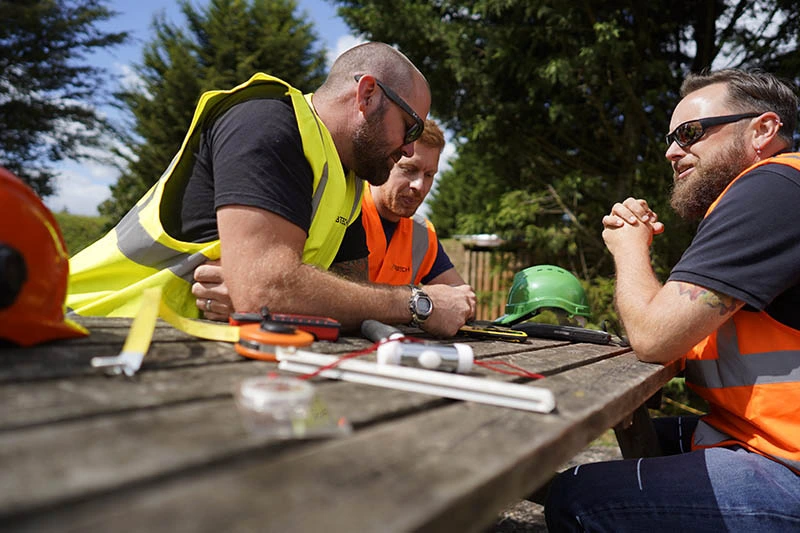
Arbtech are your best asset when it comes to getting planning permission for your project. We cover the whole of the UK and we are waiting to get started on your project...
Get Your Free Quote