Why Choose Arbtech?
Watch this video to see why Arbtech are the best asset you can possibly have when you need ecology or tree surveys to help you obtain planning permission.
If your development site has any irreplaceable habitats present, you will need help or potentially struggle with meeting the biodiversity net gain (BNG) mandate.
For help, check out our informative page or reach out to our team directly.




The introduction of mandatory biodiversity net gain (BNG) has fundamentally transformed how developers treat highly sensitive and high-value sites.
Under UK planning law and such legislation as the Environment Act 2021, certain ecosystems are considered too ecologically complex to be safely traded, offset or mitigated.
Whenever your proposed development contains or borders any unique landscapes, we move away from the standard BNG market rules and instead place strict design and legal limitations on the development plans.
As the habitats can take centuries or even millennia to develop, you cannot simply restore, recreate or replace them, and you certainly can’t purchase off-site biodiversity units to make up for any losses.
Due to their age, uniqueness, species diversity and rarity, the government classifies them as deemed irreplaceable.
For instance, in some cases, the habitats have existed undisturbed since the last ice age, offering essential ecosystem services such as flood mitigation, carbon storage and resilience against climate change.
The BNG system treats them as an absolute priority, and if your development site impacts an existing irreplaceable habitat, it bypasses the standard BNG entirely.
It is incredibly difficult to secure planning consent if any of these areas are harmed, as any deterioration of irreplaceable ecosystems triggers rigorous hurdles that can easily lead to a flat refusal of your planning application unless managed with specialist ecological guidance.
Under the Biodiversity Gain Requirements (Irreplaceable Habitat) Regulations 2024, eight habitat categories are named as irreplaceable:
*needs to have been continuously wooded since at least 1600 AD
**often shortened to ‘ancient trees’ in planning discussions
***rely on specialised plants like marram grass to bind the sand
****a rare coastal salt marsh habitat
Although features like thick vegetation or ancient grasslands aren’t included in this statutory list, they are protected under wider planning policies designed to conserve regional biodiversity.
While areas with irreplaceable habitats on or near them are exempt from standard targets, developers still need to provide information related to them during the site assessment.
In that sense, the biodiversity metric handles each irreplaceable habitat in a highly structured and automatic process:
In a visit to the site at the initial design and planning stage, an ecological consultant will record irreplaceable habitat features present on the site using the statutory metric tool.
Later in the process, the local authorities will expect the developer to provide details of each baseline habitat type – including any irreplaceable habitat type on the site – that could be impacted by the development plans.
Once entered, the biodiversity metric software ensures that the existing irreplaceable habitat is automatically removed from the standard 10% BNG target.
Such habitats need an extensive period of time to restore, meaning that a standard mathematical percentage cannot apply.
The metric divides the red line boundary into the irreplaceable habitat zone and the other non-irreplaceable habitat present on the site.
You cannot use enhancements in the standard zone to compensate for damage in the irreplaceable zone.
If your layout causes any direct loss or deterioration to an irreplaceable habitat, the metric tool immediately blocks standard scoring and triggers an automatic red flag.
The system will then alert you that the areas need to be managed outside of standard calculations.
Under the National Planning Policy Framework (NPPF), the local planning authority is instructed to refuse planning permission for any planning project that causes the loss or degradation of irreplaceable habitats.
The only exception to this is if you can demonstrate exceptional circumstances where the public benefit of your development clearly outweighs the ecological loss. In order to get past this point, strong justification will be needed during the planning application stage.
If you manage to secure approval under such rare circumstances, you need to negotiate a compensation strategy with the local authority.
You cannot buy standard off-site biodiversity units or statutory biodiversity credits to resolve this. Instead, you need to deliver a bespoke compensation plan based on agreeing bespoke compensation actions directly with the local planning authority.
With these special arrangements, the compensation rules are decided on a case-by-case basis, and they’re highly complex.
The compensation requirements often need:
In terms of the most impactful and cost-effective approach, the ideal outcome would be to design your development entirely outside of any irreplaceable zones.
To protect habitats from root compaction, hydrological changes and pollution, strict buffer zones are needed, such as for:
A minimum 15-metre semi-natural buffer zone between the woodland boundary and any construction activities.
No access roads, buildings or sustainable drainage systems (SuDS) are permitted.
The buffer must be a radius of 15 times the diameter of the tree trunk, five metres beyond the edge of the canopy’s drip line or whichever of the two factors is larger.

Early-stage planning is the most important asset when it comes to dealing with irreplaceable habitats on a site subject to biodiversity net gain (BNG).
All developers and planners are advised to cross-reference their site boundaries against the ancient woodland inventory and other statutory databases before finalising any architectural layouts.
Working on ways to avoid impacting irreplaceable habitat areas from the start of the design process keeps your planning project compliant, maintains costs at a manageable level, and prevents costly delays and planning refusals.
To help you navigate this successfully, the government has released new guidance on how irreplaceable habitat features must be handled in your layout.
In order to satisfy every BNG requirement, it’s important to bear in mind a few key nuances:
If the irreplaceable habitat on your site faces no construction impacts, you could choose to enhance it.
The metric allows you to record enhancements of irreplaceable habitats in your baseline calculation.
If the works cause no net loss or damage, they can actively increase the overall biodiversity value of your site and contribute towards your final BNG calculation of post-development biodiversity units.
Even though the statutory list is locked to the eight habitats above, some local planning authorities maintain their own wider local definitions of irreplaceable habitats within the corresponding Local Plan.
As a developer, it is your duty to meet both local planning constraints and national statutory regulations to minimise adverse impacts on the environment and respect local communities.
If you are managing a phased development, you need to outline how you will protect irreplaceable habitats across every stage of the build.
More specifically, you will need to create a clear breakdown of the protections within your final biodiversity gain plan before any physical work can start under the permissions granted.
It won’t be a surprise to learn that it can be complicated for someone to work within the space between staging a new development and protecting centuries-old ecosystems.
The team at Arbtech has specialist knowledge of biodiversity net gain (BNG), irreplaceable habitats and other factors related to ecology in connection with planning projects.
We can assist developers using our extensive expertise in BNG and all things ecology. Our ecological consultants understand the deep mechanics of the statutory metric inside out, allowing us to isolate your irreplaceable zones while maximising the development potential of all standard areas.
Working with highly protected habitats can be extremely challenging. But for our team, it’s something we deal with every day, helping clients all over the country to secure planning permission.
If you want help with clearing these ecological hurdles or other obstacles getting between you and a successful planning application, speak to our team today.
You can email us, call us, message us on one of our socials or fill out a contact form on our website. From there, we can work out what you need, give you a free quote for the relevant services, and plan a date to visit your site.

Editor at Arbtech, Rob is a content specialist who manages our ecology and arboriculture services copy to ensure it is accurate, up to date, and insightful for current and future clients.
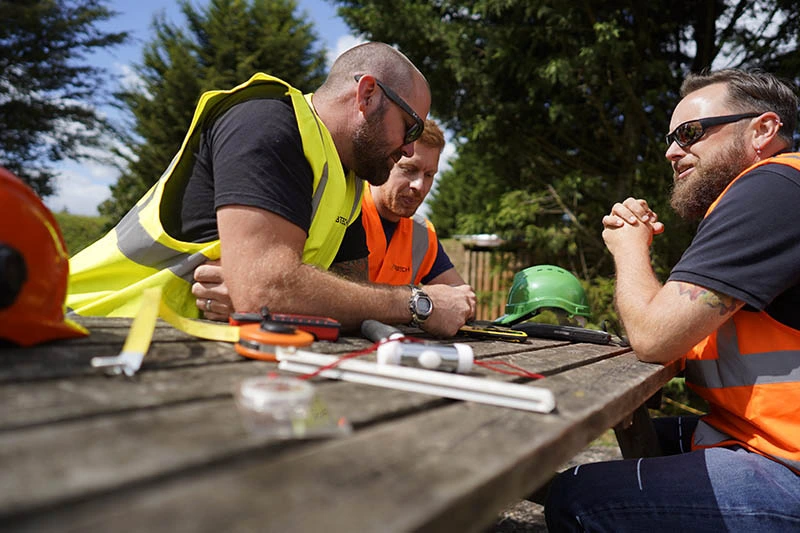
Arbtech are your best asset when it comes to getting planning permission for your project. We cover the whole of the UK and we are waiting to get started on your project...
Get Your Free Quote