Why Choose Arbtech?
Watch this video to see why Arbtech are the best asset you can possibly have when you need ecology or tree surveys to help you obtain planning permission.
With the help of wildlife fencing, you can guarantee that construction and development projects aren’t a risk to various protected species. From newt fencing and reptile fencing to badger gates, and between temporary, semi-permanent and permanent options for wildlife exclusion, containment and direction, wildlife fencing can support ecological features in a number of ways.



Wildlife Fencing Solutions for Development Sites
When you start a construction or development project, keeping local wildlife safe is a legal priority. Wildlife fencing acts as a physical barrier to manage animal movement, preventing protected species from entering hazardous work zones. Implementing the correct fencing ensures you satisfy the Wildlife and Countryside Act 1981 and move your project forward without legal delays.
Main Types of Ecological Fencing:
Exclusion Fencing: Completely blocks protected species from entering high-risk construction zones.
Containment & Translocation: Keeps captured animals safely inside a designated receptor site.
Drift Fencing: Acts as a funnel to direct wildlife toward survey traps or safe underpasses.
Species-Specific Options:
Great Crested Newts & Amphibians: Uses UV-stabilised membranes with top turns and underlocks to stop climbing or crawling.
Badgers: Employs high-tensile mesh buried deep with underground skirts and one-way gates.
Reptiles & Otters: Utilises smooth, slippery barriers for lizards and snakes, or tall cranked mesh for otters.
Water Voles: Uses chew-resistant, tall barriers near watercourses.
Lifespan and Materials: Depending on your project timeframe, you can choose between temporary polythene for short-term trapping, semi-permanent timber-supported HDPE for multi-year builds, or permanent steel mesh designed to last over 15 years.
How We Help: While Arbtech does not install the barriers directly, we provide the expert ecological advice you need for your master plan. We will refer you to our trusted specialist partner company to handle the precise installation and GPS marking, ensuring your site fully satisfies your local council.
Get straight to the point and secure your project. Contact us today for a free quote.

In all construction and development projects, it is a legal and ethical priority to make sure that local wildlife is safe.
Wildlife fencing is effective at managing the movement of animals across a development site, preventing burrowing, climbing or generally relocating into potentially dangerous areas.
We can help clients with installing fencing to support the safety of protected species and meet ecological regulations.
The installation of fencing needs to be done with technical precision and a deep understanding of wildlife behaviour. Without that, it won’t satisfy the requirements of the Wildlife and Countryside Act 1981 and the Environment Act 2021.
Any time ecological fencing is installed, the top priority is the physical safety of the species being managed. It guarantees this by ensuring that the materials are high-quality and completely free from sharp edges and snagging points.
All mitigation strategies are closely aligned with the National Planning Policy Framework (NPPF), and that extends to the use of wildlife fencing. It is designed to support the long-term biodiversity goals of development sites, offering assurances that the temporary disruption of construction or demolition work does not lead to a permanent loss of habitat.
By following professional installation standards, the environmental impact of the works can be maintained. On top of that, the planning project can move forward without any sort of legal intervention.
Choosing the right fencing solutions depends on the goals of your ecological management plan.
At different points in the development process, you are more or less likely to interact with the local fauna.
Due to this, there are three main options to guide, contain or exclude wildlife on or near the site:
Acting as a definitive physical barrier, wildlife exclusion fencing keeps protected species out of a high-risk construction zone.
It is the primary tool used to sterilise a site before any heavy machinery arrives.
During the capture and move phase, containment and translocation fencing are key.
All animals are released into a secure receptor site with specialised fencing to ensure that the wildlife remains safely in the new habitat.
Rather than a perimeter, drift fencing and directional lines act as funnels.
The affected wildlife will be led towards specific survey traps, permanent passpoints or underpasses.
Each type of wildlife barrier will be more or less effective based on the target animal. For instance, a fence designed for a climbing amphibian will function completely differently from one designed for a digging mammal.
Using different species-specific solutions, developers and planners can be certain that it is physically impossible for the protected species to breach it.
As badgers are powerful burrowers, high-tensile mesh buried deep with an underground skirt is needed to keep them from going where they shouldn’t be.
For sett closures, specialised badger gates are used, allowing animals to exit safely but blocking them from returning.
Commonly known as newt fencing, barriers for amphibians use UV-stabilised membranes.
All possibilities are covered, with a top turn preventing them from climbing over and an underlock preventing them from crawling underneath.
While a taller mesh with a cranked top is used for otters, a smooth-faced solid barrier is used for reptiles.
Using a surface that reptiles would find to be too slippery to climb and too hard to break into, snakes and lizards are unable to breach the perimeter.
Necessary on any construction sites on or near watercourses, the barriers need to be solid and tall.
Chew-resistant material and a high enough barrier are needed to prevent voles from gnawing and scaling past it.

From remote rural landscapes to complex urban areas, wildlife fencing can help with developments of all shapes and sizes.
Our team consists of experts in ecology and arboriculture, and for anything else, we can refer to a reputable partner company.
For ecological fencing solutions, we’re able to pass you on to a company we work with for a consultation and full management of the installation process.
Selecting the right material based on the site, the project and the present species is the best way to ensure that your planning project remains cost-effective while satisfying all legal obligations.
Via the team we work with, we can help you choose between the primary grades of installation:
Rigid HDPE or steel mesh systems designed for long-term (15+ years) infrastructure projects, permanent fencing is suitable for highways and railways.
Durable timber-supported HDPE panels designed for barriers, semi-permanent fencing is suitable for multi-year builds expected to withstand a variety of weather and site activity
Polythene membranes for short-term trapping and translocation phases, temporary fencing is suitable as an economical option whenever the barrier is only needed for a few months.
Every development is unique, and our costing process reflects the specific variables of your site.
Key factors that influence the final quote price include the total linear meterage, the complexity of the terrain, and the specific burial depths required for wildlife exclusion, containment or direction.
Although it is possible to buy online, improper installation is a leading cause of licence failures. With this in mind, it would always be advisable to refer to a specialist, such as the team we work with.
Under the guidance of our partner team, the installation can be professionally carried out and follow GPS marking to guarantee that the fence line is consistent with your ecological master plan.
Even though the team at Arbtech doesn’t install wildlife fencing directly, the process for getting a quote via our team is quick and easy.
All you need to do is contact our team by filling out a quote form, calling us or sending us an email. At this point, give us as much information about your development site and planning project as possible, and from there, we can recommend the right services for you.
Contact us today and take the first step in working out what wildlife fencing you need to meet the requirements of your local council and move forward with your plans.

Editor at Arbtech, Rob is a content specialist who manages our ecology and arboriculture services copy to ensure it is accurate, up to date, and insightful for current and future clients.
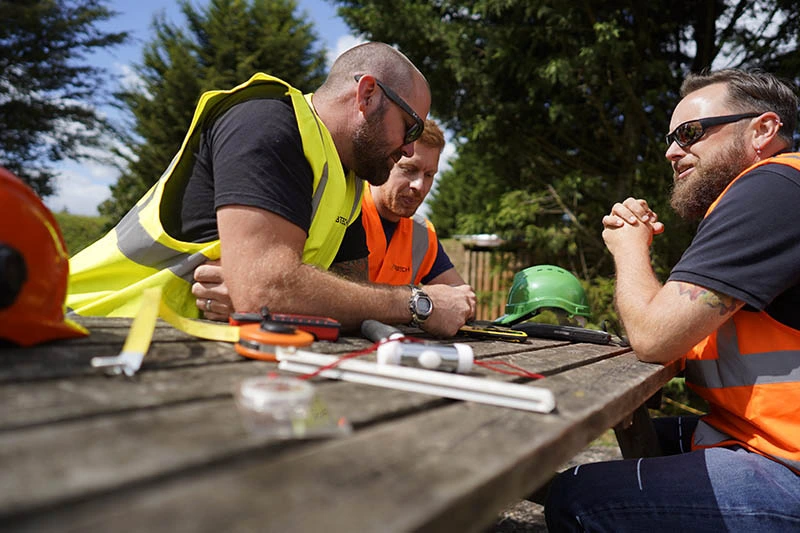
Arbtech are your best asset when it comes to getting planning permission for your project. We cover the whole of the UK and we are waiting to get started on your project...
Get Your Free Quote