
While former industrial land may appear to be an unwelcoming environment for wildlife, with the right approach, such areas can become valuable pockets of nature.
Contaminated land includes sites of former refineries, heavy industries or landfill, and while it has many challenges, it can be rehabilitated and transformed.
Across the UK, former industrial land and radioactive contaminated land is being reclaimed and restored as nature reserves, wetlands and community green space, alive with bees, wildflowers, reptiles and birds. The transformation is a combination of practical engineering, environmental protection and increasingly, planning policy.
This article provides the legal definition of `contaminated land’ and outlines how it’s identified and managed through the planning system, before featuring some high-profile projects that demonstrate how even the most polluted areas of land affected by contamination can become wildlife havens.

What is contaminated land?
In the UK, the legal framework for contaminated land sits largely under Part iia of the Environmental Protection Act 1990. In simple terms, the legal definition of contaminated land is any site where substances in, on or under the ground are causing, or are likely to cause, significant harm to human health or the environment, or are polluting controlled waters. Local authorities must have a contaminated land regime, which includes inspecting and identifying potentially contaminated land and, where necessary, overseeing remediation.
Planning guidance complements the statutory approach to land contamination. The National Planning Policy Framework (NPPF) provides further guidance and makes clear that developers and landowners must ensure that land is “suitable for its new use” and that planning decisions should take contamination risks into account when deciding on planning conditions. In practice, this means a contaminated land survey involving site investigations to assess previous use, risk assessments and, if required, remediation plans that become part of planning applications. Geo-environmental consultants adopt a staged approach which involves a desk study of historic maps and records, followed by an intrusive site investigation and risk assessment against relevant receptors (people, wildlife, groundwater), and remedial work if needed.
The government’s Land affected by contamination guidance explains how planning authorities should approach the environmental impacts of contaminated land in the development process. Local authorities typically publish a `contaminated land strategy,’ along with developer guidance setting out the technical steps to assess land contamination levels. There is also a public register of contaminated land sites.

Land contamination issues and the planning process
Potential risks of significant harm exist from contaminated land containing radioactive substances, heavy metals, tars, solvents, asbestos, persistent organic pollutants and old mine spoil. Left unmanaged they can pose direct human health risks, contaminate groundwater, or make land unsafe for housing or other proposed development.
But, crucially for conservation, many brownfield and former industrial use sites with significant pollution issues have also become refuges for wildlife precisely because they were left alone, have low-nutrient soils or a mosaic of micro-habitats – conditions that favour rare plants, invertebrates and pioneer species. Buglife and other conservation groups have long argued that brownfields can be biodiversity hotspots.
This dual reality of hazard on one hand, wildlife on the other, means that restoration projects must strike a careful balance between protecting people and water and, where possible, retaining or recreating features that wildlife needs.

How contaminated land is made safe and wildlife-friendly
Remediating contaminated land is a very site-specific process, depending on the pollutant, previous use, the site’s geology, intended future users and cost. Common approaches include:
- Containment and capping: placing an impermeable or engineered cap over contaminated material (typical for closed landfill). The soil and vegetation above the cap can then support green space and habitat while preventing contact with underlying waste or lead oils. The Thurrock Thameside Nature Park at Mucking, Stanford-le-Hope, was created on a capped landfill and now supports grassland, scrub, ponds and reedbeds; this example combines engineered containment with habitat creation.
- Excavation and removal: where contamination is localised and removal is feasible, contaminated soils are dug out and taken to a licensed facility for disposal.
- In-situ treatments: these involve chemical, thermal or biological treatments that neutralise contaminants without major earthworks.
- Phytoremediation and ecological engineering: using plants, microbes or wetland systems to stabilise or extract contaminants. The process is often slower but has lower impact and may be compatible with habitat objectives.
Engineering and ecology are combined with long-term monitoring (gas and leachate monitoring on landfill caps, chemical substances, groundwater testing) to ensure safety from any such harm as may be present. Data on historic landfill sites is publicly available (for example the UK Historic Landfill dataset), which helps planners and conservationists identify potential sites and their risks.
Planning law and the contaminated land regime
Under the planning regime, developers and landowners are responsible for demonstrating that land is suitable for its intended use and for future users; the local planning authority, lead regulators, the Department for Rural Affairs and the Environment Agency must be satisfied that there are no unacceptable risks before granting permission for a proposed development on former industrial areas. Where land is designated a `special site’ under Part iia or where there is a significant possibility of harm, regulators may require remediation work to deal with such pollution and can recover costs from the original polluter where they can be identified.
Funding for restoration can come from landowners, developers, landfill-operator trusts (such as Biffa Award grants), public bodies and charitable sources. The Biffa Award for rebuilding biodiversity and The Land Trust are examples of funding/ownership models that have supported brownfield rehabilitation and community access projects.
Success stories
A number of UK projects show how contaminated, or brownfield land can be transformed into wildlife havens, often surpassing expectations for biodiversity.
Canvey Wick (Essex)
Canvey Wick, a former oil refinery and brownfield land area, is now one of Britain’s most important sites for rare invertebrates. It is a designated Site of Special Scientific Interest and surveys have recorded thousands of species across plants, insects and birds. The site demonstrates how a mosaic of bare ground, sandy substrate and early successional habitats supports specialist bees, beetles and butterflies that are scarce elsewhere. The RSPB, Buglife and the Land Trust have worked in partnership on habitat management in recent years.
Thurrock Thameside Nature Park
Once Europe’s largest landfill, this site has been capped and landscaped; the Thameside Nature Park now includes grassland, reedbed and new woodland and is managed by Essex Wildlife Trust. The visitor centre (ingeniously built on hydraulic jacks to allow for settlement) overlooks estuarine mudflats that are internationally important for wintering waders. Sir David Attenborough opened the park and praised it as a model of nature restoration, saying:
Positive change like this must become the norm.

The Flashes (Wigan and Leigh)
Large areas of mining-subsidence lakes in Greater Manchester have evolved into species-rich wetland mosaics. Natural England recently recognised The Flashes as a major urban nature reserve, where bitterns, willow tits and water voles have benefited from large-scale habitat recovery. This is an example of reclamation combined with natural recolonisation delivering value at landscape scale.
Northumberlandia and restored opencast sites
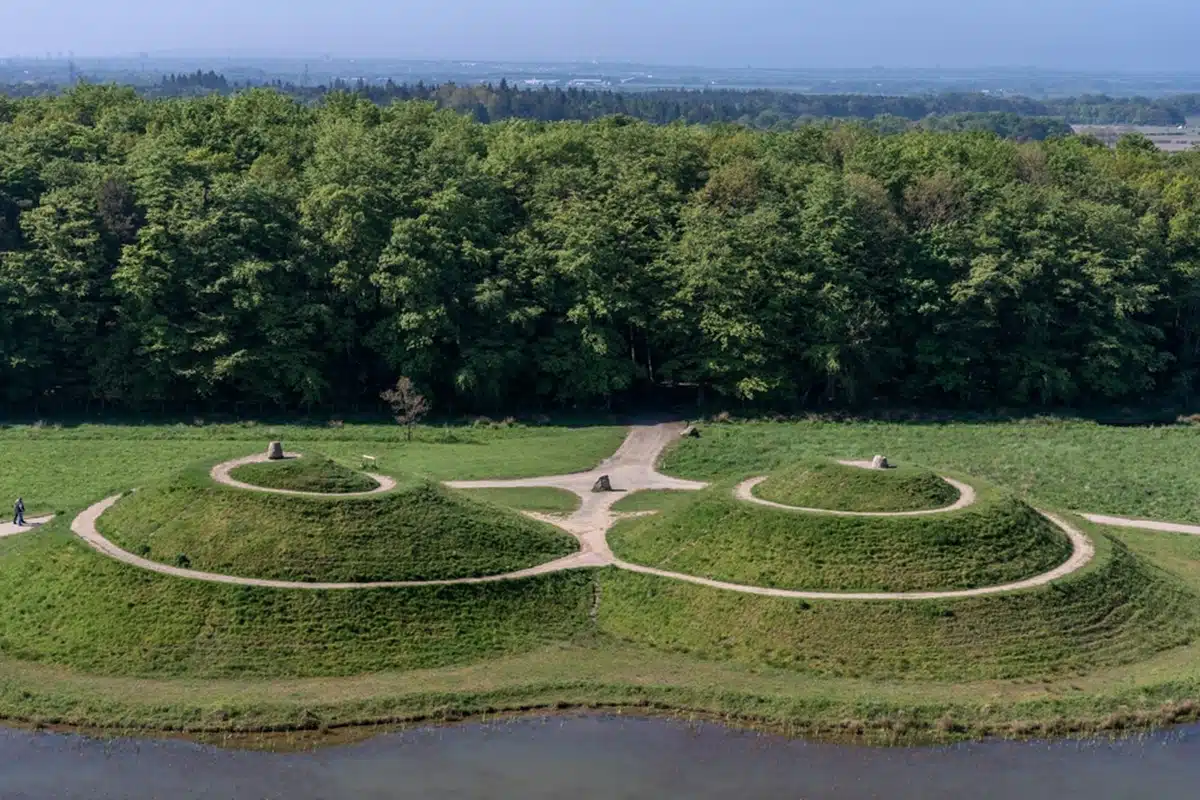
Northumberlandia is a giant land sculpture created from mine waste as part of an opencast mine restoration. Managed as a public park by Northumberland Wildlife Trust, it now supports varied vegetation and wildlife, illustrating how engineered restoration can provide both community amenity and wildlife value.
These innovative land use projects share common success factors: long-term funding or stewardship, partnership working (NGOs, landowners, councils), and careful design that balances engineering constraints with habitat needs.

Why land affected by contamination can be so valuable for wildlife
Brownfields and contaminated lands commonly have low-nutrient soils, varied substrates, bare ground and a patchwork of micro-habitats; conditions that many rare invertebrates, pioneer plants and reptiles favour. Buglife’s research has shown that some brownfield sites score among the most biodiverse places in the UK when measured by specialist invertebrate numbers. That’s why conservationists often argue these areas should be surveyed and, where appropriate, protected rather than assumed to be `low value’ for nature.
Buglife and the Land Trust emphasise that brownfield sites are often havens for rare invertebrates and call for targeted surveys before redevelopment. According to Buglife, preserving brownfield mosaics is essential for many species that cannot survive in well-worked, nutrient-rich countryside.
The trade-offs and the limits
Not all land affected by contamination is suitable for nature restoration. Some remain toxic to wildlife or too dangerous for public access. Challenges include:
- Long-term management and monitoring costs: landfill caps settle, monitoring wells and gas vents need maintenance.
- Conflicting policy pressures: brownfields are also prime targets for housing and industry; conservationists warn that development can destroy rare brownfield habitats unless carefully planned. Canvey Wick itself has faced development pressure.
- Complex remediation choices: removing contamination entirely can be prohibitively expensive; containment may be safer but constrains future use and can complicate habitat creation.
- Community expectations: turning a rubbish dump into a peaceful reserve requires time and investment: the public often expects instant results.
How policy and funding can help scale up nature recovery on contaminated land
To maximise conservation gains from contaminated and brownfield land we need:
- Early ecological survey requirements on potentially contaminated land being met to inform planning decisions so wildlife-rich brownfields are identified before permission is granted; the NPPF already requires planning to consider biodiversity value.
- Targeted funding for restoration and stewardship (charitable trusts, landfill-operator funds such as Biffa Award and local authority capital grants).
- Partnership projects that combine engineering, ecology and community access: the pattern seen at Thurrock, Canvey Wick and the Flashes.
- Long-term stewardship models: Land Trust ownership or NGO management that commit to monitoring and adaptive habitat management.
Greener futures for contaminated sites
Contaminated land is part of Britain’s industrial legacy. It’s also part of its nature recovery potential. With the right mix of engineering, planning safeguards and ecological imagination, old landfill caps, slag heaps and abandoned refineries can become thriving wildlife areas and accessible green spaces for communities.
The trick is to combine safety and ecology: clean up or contain what’s dangerous, but don’t assume `contaminated' means `valueless’. The success stories, from Canvey Wick becoming a thriving hotspot for invertebrate riches to Thurrock Thameside’s transformed landfill, show that with expertise, collaboration and long-term stewardship, even the most unlikely places can be part of a greener future.