
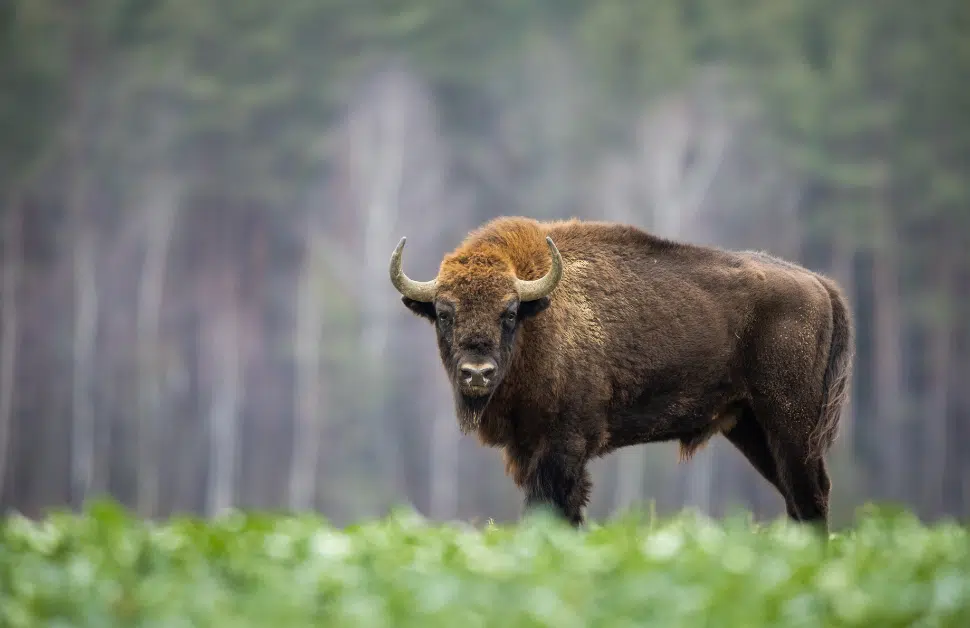
Cumbria Playing Host to Bison Rewilding
A new era of British conservation has arrived in the north of England.
In June 2026, a free-roaming herd of five European bison was released into a secure 700-acre enclosure at the 5,000-acre Castletown Estate near Carlisle in Cumbria.
Scientifically classified as bison bonasus, the European bison are the closest living relatives to the ancient steppe bison that roamed prehistoric Britain thousands of years ago.
Land managers report that the first bison to explore the estate immediately settled into the landscape, using its immense size to bash through dense vegetation and clear out the thick, woody vegetation.
By naturally felling trees, the animals bypass any need for disruptive heavy machinery, gradually altering the habitat in a natural way.
Recent Bison Introduction
The release in Cumbria builds on the success of a pioneering project in the South East of England back in July 2022.
Back then, it was a significant moment as the first wild bison stepped foot on British soil in thousands of years, as part of the Wilder Blean Project.
Led by a partnership between the Kent Wildlife Trust and the Wildwood Trust, the trial took place in West Blean and Thornden Woods – a sprawling nature reserve located near Canterbury.
After initially starting with three bison (two bison from Ireland and one from Scotland), within two years, the Blean Bison Project proved that a semi-wild herd could thrive in the UK.
Expert bison rangers like Donovan Wright monitored the bison as they settled into Blean woods, eventually watching on as the species safely navigated and restored an ancient woodland.
Integrating Bison in the UK
The decision to introduce the massive herbivores comes at a time when the UK is gripped by a severe biodiversity crisis alongside the accelerating effects of climate change.
At this point, traditional woodland management is no longer enough to stop the decline of the species. Instead, conservationists want to restore natural processes by reintroducing European bison into the remaining wild spaces.
Working the animals into our natural environment, however, involves a lot of careful planning.
Before anything can happen at all, ecologists need to consult with local landowners and various ecological interest groups to make sure that the project aims align with local agriculture.
The Cumbrian initiative has shown that free-roaming animals and commercial livestock farming can thrive side by side on a productive estate.
Benefits of a New Breeding Herd
More than anything, the primary reason to establish multiple bison herds across Britain is their status as keystone species and ecosystem engineers.
In fact, the bison’s natural behaviours create highly complex woodland habitats that help to support thousands of other species.
For instance, as the bison move through the forest, their habit of dust-bathing creates patches of bare earth on the woodland floor, which are crucial for pioneer plants and burrowing insects.
On top of that, the bison’s feeding habits open up the dense canopy, allowing sunlight to reach the forest floor and wake up otherwise dormant seed beds.
Unlike American bison, European bison are more like biological woodlanders than roamers across open prairies.
To maximise the overall biodiversity impact, bison are often paired with other ancient breeds. On rewilding sites, it can be worthwhile for them to share the land with:
- Exmoor ponies to graze on tough and fibrous grasses
- Iron Age pigs to turn over the woodland floor with their snouts
- Longhorn cattle to browse low-hanging tree scrub
Using a multi-species grazing dynamic, the wildlife can create a mosaic of open glades and sunny open areas.
Logistics Surrounding the Project’s Success
Despite the benefits of bison, you can’t simply just release them anywhere.
Under the Dangerous Wild Animals Act 1976, bison are legally classified in the same category as apex predators like cheetahs, cougars, hyenas, jaguars, leopards, lions, pumas, tigers and wolves.
Due to this, securing licenses involves bulletproof ecological advice, intensive feasibility studies and substantial investments in perimeter fencing.
Although rewilding bison in the UK comes with its obstacles, forward-thinking landowners see it as a sustainable solution for the future.
Large-scale rewilding projects can unlock incredible financial returns via units from biodiversity net gain (BNG).
As large herbivores can capture carbon dioxide in the air and store it for a long period of time at the fastest rate, the rewilding of bison has also been known to play a positive role in carbon credit schemes.

Future of Groundbreaking Wildlife Conservation
The successful expansion of bison populations into the north marks a critical milestone for UK nature recovery.
Instead of just protecting the little nature we have left, we are now actively choosing to bring a regionally extinct species back to do the physical restoration work for us.
When European bison were brought into Kent’s woodland in July 2022 through the Blean Bison Project, it was a test, and the outcome was difficult to predict.
In little to no time at all, however, it began to boost the ecological quality of West Blean and Thornden Woods and set a new blueprint for how nature recovery can be executed.
Now that the UK’s second free-roaming bison herd is officially established in Cumbria, a new chapter has begun. And seeing how successfully the bison were reintroduced in Kent gives other land managers the confidence to follow suit.
As the bison herds naturally open up overgrown canopies, the increase in light reaching the woodland’s foundation will breathe new life into our degraded soil, seed banks and insect populations.
Our Role in Safeguarding Wildlife
Everyone at Arbtech believes that there’s always a way for development and conservation to go hand in hand.
For many developers and planners, the planning process can seem difficult to work with, especially when it comes to biodiversity net gain (BNG), habitat creation and protected species licensing.
If you’re dealing with ecological constraints on your development site, Arbtech is an experienced, trustworthy, qualified and insightful option to step in and help.
Get support from our team by visiting our contact page, emailing or calling, and we can work out what you need and book an assessment at the next available opportunity.


