Last updated: March 2026

Author: Rob Lambert
Editor at Arbtech, Rob is a content specialist who manages our ecology and arboriculture services copy to ensure it is accurate, up to date, and insightful for current and future clients.
Various surveys and reports are needed before the local planning authority will even consider an application for planning permission. On our extensive page, we list many of the most common types of surveys and reports, with information on when they could be fundamental to your development.



Last updated: March 2026
Editor at Arbtech, Rob is a content specialist who manages our ecology and arboriculture services copy to ensure it is accurate, up to date, and insightful for current and future clients.
Securing planning permission can be a complex hurdle, but having the right surveys and reports is the most effective way to satisfy your local authority. Whether you are a homeowner or a developer, these documents serve as vital proof that your project meets national legislation and local regulations.
The type of report you need depends entirely on your site and the local environment. Common requirements include:
Ecology Surveys: We conduct Preliminary Ecological Appraisals (PEA) and protected species assessments (for bats, great crested newts, or badgers) to identify potential constraints early.
Tree Surveys: If trees are on or near your site, a BS5837 tree survey is the industry standard needed to manage arboricultural constraints.
Biodiversity Net Gain (BNG): Most projects now require a 10% increase in biodiversity value, which we measure and help you achieve.
Land and Building Surveys: This includes topographical surveys for accurate site layouts and measured building surveys for precise structural drawings.
Starting these assessments early prevents costly delays, especially since some surveys—like those for bats—are seasonally restricted. We provide clear, direct advice to help you navigate these requirements without the technical headache. If your application is refused based on our survey advice, we even offer a money-back guarantee to give you total peace of mind.

Working your way through the development process can see you coming up against a lot of red tape, with loads of unexpected surprises, even if you’re an experienced developer. It is a priority within the planning process, however, to ensure that every new development proposal is safe, sustainable and respectful of the local environment.
With this in mind, you will need to satisfy your local planning authority. To do that, you might need to provide specific reports for planning applications as proof that your plans meet local regulations and national legislation. And in most cases, the planning department will insist on further surveys if an initial survey identifies potential impacts on the local area.
It could be that you’re working on a simple house extension, or you might be in charge of a major development. Whatever the situation, getting the right professional advice from planning consultants early in the process is vital.
Our team helps you to ensure compliance with the National Planning Policy Framework (NPPF) and building regulations, giving you the best chance of planning success. By following our advice and identifying potential issues at the pre-development phase, you can save money and avoid costly delays.
Whenever you submit planning applications, the planning officer from your local council must consider the impact on the natural environment.
Ecological surveys are an essential part of applications for planning permission, helping to identify ecological features and likely ecological constraints on the proposed site.
Our ecological consultants use desk-based research and local record centres to gather further information about the site and the presence of ecological assets before starting any survey work.
As the starting point in the ecology survey process, common assessments include preliminary ecological appraisals (PEAs) (formerly the extended phase 1 habitat survey), ecological impact assessments (EcIAs), environmental impact assessments (EIAs) and ecological walkover surveys.
We understand many factors could impact your timeline, so we provide the due diligence needed to determine planning applications efficiently. By assessing ecological conditions and identifying valuable habitats, we help you navigate the assessment process and meet the goals of the nature conservation community and the UK Biodiversity Action Plan.
Addressing ecological issues requires a qualified ecologist who understands how to support planning applications on most sites. Whether your project involves previously developed land or protected sites, an ecological assessment will identify if additional surveys are needed for a particular species.
Our ecological consultancy provides the PEA report and EcIA report data that Natural England and local environmental records centres require to make informed planning decisions.
We identify invasive plant species that could compromise your development site, like Japanese knotweed, Himalayan balsam, giant hogweed and injurious weeds.
Our ecology consultants perform a site visit and retrieve all the information needed to manage the potential constraints of such plant species.
Alongside surveys for each of the rare plants, we also offer a problematic species audit and a problematic species management plan to ensure clients meet relevant legislation and address invasive or valuable plants correctly.
To support protected species, we offer a range of detailed surveys, known as habitat surveys.
The process often starts with a preliminary roost assessment (PRA) for bats, barn owls and other roosting creatures or a preliminary ecological appraisal (PEA), ecological impact assessment (EcIA) or ecological walkover survey to look for the potential presence of great crested newts, water voles, white-clawed crayfish and other protected species.
Many of the animal species are seasonally constrained, with the survey season being different for certain species. For instance, bird surveys for breeding birds or bat surveys of potential roosting sites and cave-like spaces need to happen at the right time of year. As such, it’s important to follow the ecology survey calendar.
Our ecological surveyors are members of the Chartered Institute of Ecology and Environmental Management (CIEEM), ensuring that your ecology reports are of the highest standards. From summer months to winter months, we conduct field surveys to determine if further detailed surveys or a habitats regulations assessment (HRA) are needed, especially if the development involves special protection areas (SPAs) or special areas of conservation (SAC).
Under the Environment Act 2021 (previously the Environment Bill), biodiversity net gain (BNG) requires most property or land development projects to achieve net gains in biodiversity value, leaving local wildlife in a better state than before.
Our trained ecologists use a biodiversity checklist to measure existing habitats and natural assets against your proposed development project. From there, we can then go on to retain that value and improve upon it by a further 10% increase, or more if requested by the local authority.
To prevent biodiversity losses and boost the necessary increase, we follow the mitigation hierarchy. In order of the best to worst outcomes, it encourages developers to avoid, occupy and – as a last resort – refer to compensation and mitigation strategies.
With our biodiversity net gain assessment and BNG rapid risk report, you can meet legally binding environmental targets while protecting important habitats and ancient woodland. We can also help with other elements of the BNG mandate to ensure the ecological maintained via a habitat management and monitoring plan (HMMP) and a river condition assessment (RCA).
If there are trees present on or near your proposed development area, you will need a tree survey.
A BS5837 tree survey is the British standard assessment needed for planning purposes. It involves our tree surveyors evaluating the physiological and structural condition, age class or relevant existing trees.
Among our professional tree services are a BS5837 survey, a tree constraints plan (TCP) to show root protection areas (RPAs) and crown spread, an arboricultural impact assessment (AIA) to consider tree removal or tree retention, and a tree protection plan (TPP) and arboricultural method statement (AMS) to safeguard and manage any impact on retained trees.
By considering tree survey requirements – such as the influencing distance, tree roots and creating specific tree survey reports – we help the tree officer from the local council understand how you will handle statutory controls like tree preservation orders (TPOs) and conservation areas.
It could be that you have a single tree under protection or multiple important trees in close proximity to the build – whatever the situation, our arboricultural consultancy guarantees that your proposed layout is viable. On top of providing tree reports to assess the structural integrity of present or nearby trees, we also offer VALID tree risk management, CAVAT tree assessments, mortgage tree reports, arboricultural supervision and site monitoring, and more.
Our experts undertake tree surveys to address safety concerns and the structural integrity of relevant trees. It acts as the first part of ensuring planning approval, as it identifies the retention value and development potential of the land. We provide useful information and provide recommendations to ensure you are protecting trees in line with planning regulations.
By providing these individual documents early, we help you undertake surveys that prevent an adverse impact construction activity might have on tree-protected assets.
Dealing with complex tree structures requires a specialised approach to ensure safety and compliance. We provide the additional information needed to manage certain types of arboricultural constraints, ensuring your project meets all planning requirements on the same level as national standards.
A site survey often begins with topographical surveys to create the proposed layout with informed decisions based on accurate data regarding the dimensions of the potential development site and land use.
Our team works with a trusted partner company for land surveys, helping to support the actions of land owners, land agents, lawyers, solicitors, developers and planners with accurate data about the site.
In addition to a topographical survey, the land surveyors we work with can undertake a boundary survey, utility survey and a visual impact assessment (VIA).
When you’re making changes to an existing property, you need accurate data to optimise your development plans and streamline the application process.
Depending on the aims of your project, you could need any number of building surveys. For example, a measured building survey (MBS) will give you precise drawings of your building’s dimensions, a condition report will confirm the current stage of your building, and a 3D survey will create an exact digital drawing of your building’s interior and exterior.
If your proposed development site is in flood zone 2, flood zone 3 or flood zone 3B, a flood risk assessment (FRA) will be needed to retrieve information required by the Environment Agency (EA).
We analyse risk data to determine flooding from rivers, surface water flooding, reservoir flood and any other sources of flooding from rivers or sea areas.
Whether you’re in a critical drainage area or near a main river, our flood risk specialist can give you the detailed analysis you need for minor developments and essential infrastructure.
Our team assesses flood defences, residual risks and the impacts of climate change to create robust drainage strategies. We can also provide a flood emergency plan (FEP), flood consequence assessment for developments in Wales, flood modelling and a CCTV drainage survey if you need any of these services to navigate local planning policies and satisfy the lead local flood authority (LLFA).
For brownfield land or sites with a past industrial use, land contamination reports are mandatory.
We start with a preliminary risk assessment known as a phase 1 report, which involves an initial desk study and site walkover survey. If we identify potential sources of contamination or groundwater contamination, we can then refer you to an intrusive site investigation.
A lot of different elements are part of our contaminated land services, including the use of soil samples, trial pits and gas monitoring for ground gases to ensure the proposed use is safe for the local area. Our specific requirements for laboratory analysis and groundwater protection ensure that even the most complex building work remains safe for future occupants.
Our geo-environmental consultants can develop a remediation strategy and conceptual site model in line with Environment Agency (EA) guidance and National House Building Council (NHBC) standards, ensuring that any planning condition imposed as a result of land contamination is fully discharged.
In terms of related services, we can also carry out a coal mining risk assessment, ground gas risk assessment, ground stability assessment or materials management plan (MMP).
A landscape assessment ensures good design and protects the well-being of the surrounding area.
We consider green infrastructure and how the development for the proposed location fits into the local environment. To provide the planning committee with a clear understanding of the potential effects of development on the surrounding area, we offer a full suite of specialised services.
Our core offering includes a landscape and visual impact assessment (LVIA) and a landscape visual appraisal (LVA), which are often needed to work out how a new build alters the character of the local area. Alternatively, we also carry out a townscape and visual impact assessment (TVIA) and townscape and visual appraisal (TVA) for developments in urban settings.
For sites in sensitive locations, we offer a green belt impact assessment (GBIA), green infrastructure planning and a heritage impact assessment (HIA). To ensure long-term sustainability, we are able to produce a landscape and ecological management plan (LEMP) or a design and access statement (DAS)
Other landscape services we can help with include visual envelope mapping (VEM) and zone of theoretical visibility (ZTV), viewpoint assessments, landscape capacity study, landscape sensitivity and capacity assessment (LSCA), strategic landscape planning, facade analysis, cumulative impact assessment (CIA), and a daylight and sunlight assessment of natural light calculations.
By integrating natural assets into your proposed layout, we help you to meet local planning policies and avoid adverse effects on the natural environment.
Poor air quality is a major public health concern, especially in urban areas and air quality management areas. In fact, in many London Boroughs, you need to demonstrate being air quality neutral to satisfy environmental health officers.
Our air quality consultants offer air quality assessment services, including air quality neutral assessments, dust services for controlling dust (dust assessment and dust management plan), odour assessment, damage cost calculations and dispersion modelling assessments using ADMS roads. We also provide indoor air quality monitoring services, air quality testing to address air quality issues early, baseline air quality strategies, and the option of a basic air quality assessment or a detailed air quality assessment.
Through the work we do, we help you to meet national air quality objectives and legally binding limits for nitrogen dioxide and particulate matter. For projects involving a combustion plant, extraction systems, power plants, biomass boilers or combined heat and power, we ensure that your pollutant emissions remain within acceptable levels.
Linked to our landscape surveys, we can also arrange a construction environmental management plan (CEMP) to manage construction dust, air pollutants and pollution emissions, such as sulphur dioxide. We will regularly review the modelling data against planning guidance to ensure that any new exposure is kept to a minimum.
Between implementing low-emission strategies and investing in electric vehicle charging points, developers and planners are able to help reduce exposure to air pollution and meet air quality action plans.
To avoid adverse effects on sensitive receptors, a noise assessment may require prior notification.
We gauge the traffic volumes caused by expected traffic congestion to ensure that acceptable levels of noise aren’t exceeded.
Our noise impact assessments cover both the construction phase and all operational phases of your development, and use modelling data to provide appropriate mitigation for point sources of noise, ensuring the well-being of the surrounding area is maintained.
Excessive light can impact biodiversity and local wildlife.
We can arrange for a partner company we work with to carry out lighting assessments as a way of ensuring that your development doesn’t cause light pollution, especially in sites of special scientific interest (SSSI).
In any locations with protected habitats or near to or on special protection areas (SPAs), an assessment will provide vital supporting information and ensure that the potential effects of artificial lights are strictly controlled.
Before you go ahead with any type of excavation on a location with historic value, an archaeological survey will be needed to check for heritage assets.
A partner company we work with will carry out desk-based research and an in-person field study to identify if your proposed site holds any historical significance.
If the desk study information or the site visit suggests a likely presence of historical remains, our external archaeological surveyors can undertake further investigation to avoid significant effects on national heritage and ensure that all regulatory requirements are met.

Working your way towards getting planning permission is an early-stage priority.
To gather information and secure planning consent, you must follow UK law and ensure that all types of ecological constraints are mapped out. The team at Arbtech can help with our proven record of delivering cost-effective reports that act as the first stage of your project’s success.
Any delays in further survey work or obtaining an ecological report can stall your planning applications for three months or more. By acting as early as possible, we help you understand exactly what may be required for your proposed location, from a strategic flood risk assessment to a site-specific assessment for certain protected species.
In many ways, the success of your project depends on how you handle certain areas of the application process. Whether you are working during different times of the year or facing different types of site constraints, our team is equipped to help.
Although the most common type of hurdle in getting planning permission is either trees or ecology, an important consideration for any project is air quality. If an air quality assessment required by your local council is pending, or if an air quality assessment needed for environmental permitting arises, we provide the expert data required.
We follow the latest construction guidance for construction sites, recognising that planning requirements will differ depending on whether you are introducing new point sources of emissions or working near listed buildings.
Between conducting a botanical survey to identify notable species and reviewing national vegetation classification (NVC) data for priority habitats, and from managing air quality impacts on local air quality to handling contaminated land reports on previously developed land, we provide the detailed information you need and undertake surveys at the optimal periods.
Our team recognises that different times in the development cycle require different levels of support. By identifying important factors early, we can offer compensation measures and biodiversity assessments to keep your project moving – the proactive support you need to guarantee a seamless path to approval.
If you have common questions about ecology survey cost, the current Department for Environment, Food and Rural Affairs (DEFRA) guidance or booking an environmental impact assessment (EIA), for example, the team at Arbtech is here to help.
Simply reach out to our team to discuss the area affected and let us take further action. Fill out our booking form on our website, call us or email us to receive a free quote and provide information about your project.
We work throughout the year to ensure that you can meet planning conditions from your local planning authority quickly. As long as you get in touch with us ahead of time and give us as much information as possible, we will be able to guide you with the next steps to take.
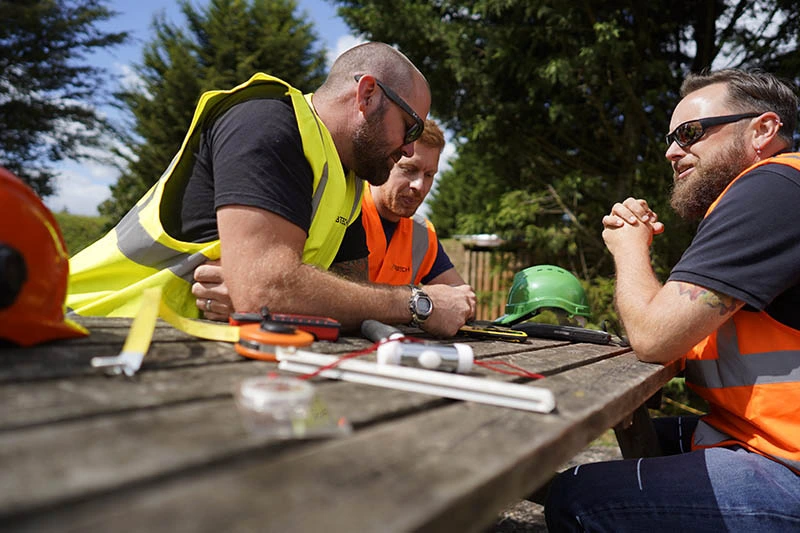
Arbtech are your best asset when it comes to getting planning permission for your project. We cover the whole of the UK and we are waiting to get started on your project...
Get Your Free Quote